
 October 16, 2026
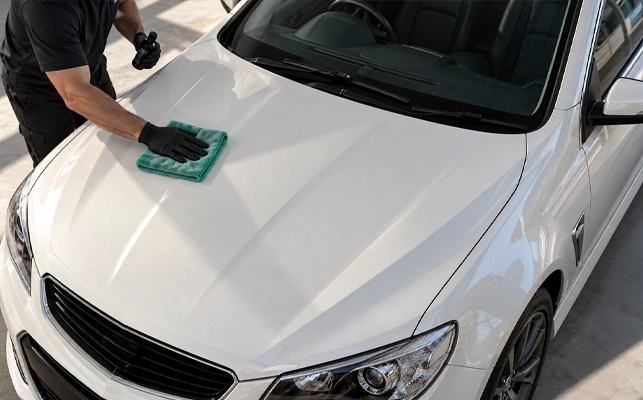
Start in the first few weeks, before there is anything to fix. A new car’s paint is the best it will ever be, which makes it the one time you can protect a finish without correcting it first. The real question is not whether to detail a new car. It is which decisions belong in the first month, and which can safely wait.
This is for anyone who has just taken delivery in Parramatta. You are being offered a protection package, a maintenance plan and a first service at once. Three of those decisions actually matter early. The rest can wait.
The advantage of a new car is that nothing needs correcting yet
On an older car, protection is the last step of a longer job. The paint has to be decontaminated and polished before anything goes over the top, because sealing a dull finish just locks the dullness in.
CarsGuide makes the same point about used cars: “Paint protection can also be applied to second-hand used cars, though often these vehicles will need to have a professional detailer to a full paint correction detail first.”
A new car skips that entirely. There are no swirl marks to cut out and no bonded contamination to clay off. The work is shorter, and the finish underneath is already the best it will be. That is the argument for acting early, and it is a practical one rather than a sales one. If you are weighing up whether professional work is worth it at all, we have argued it both ways in are car detailers worth it.
Decision one: the protection package offered at delivery
Most buyers meet this decision in the business manager’s office, at the end of a long day, with the paperwork already open. It is worth slowing down.
The first thing to establish is what is actually being applied. CarsGuide describes dealer paint protection as “generally a chemical spray put on by the dealer or a qualified detailer”, which covers a wide range of products with very different lifespans. Ask which product it is, who applies it, and what upkeep it expects from you.
The second thing is the paperwork. The ACCC states that “Consumer guarantee rights apply under the Australian Consumer Law to new and second-hand cars purchased from a licensed dealer.” Keep whatever documentation comes with a treatment, along with the product name and application date, in the same place as your service records.
You do not have to decide at the desk. Protection can be applied after delivery by whoever you choose, and the paint will still be uncorrected either way. Want the differences between wax, ceramic coating and paint protection film first? That comparison sits in our guide to car paint protection in Parramatta.
Decision two: how the car gets washed from the first week
This is the decision that quietly does the most damage, because a wash routine is set in the first month and then repeated for years.
Fine swirl marks are added by washing and drying, not by driving. RACV’s method reduces the risk: “To minimise the risk of scratching the paint, use two buckets: one with the soapy water, and one with clean water to rinse your sponge or mitt.” It also recommends a soft sponge or microfibre mitt to clean the surface.
Products matter as much as technique. RAC WA’s guidance covers both together, and frames washing frequency as a ceiling rather than a schedule: “To keep your car’s exterior in good shape, we recommend you wash it no more than once a fortnight, with quality car cleaning products.” Its list of things to avoid is short and specific — dishwashing liquid instead of car shampoo, and drying with “a smooth cloth, soft towel or old T-shirt”, which “could potentially cause micro-scratches”. It also says to wash “in a covered or shady area without exposure to direct sunlight”.
Which is most of the argument for hand washing a car this new, and we have set it out properly in hand car wash versus automatic.
Decision three: the cabin, which starts ageing immediately
The dashboard is the part of a new interior that changes first, and it is easy to leave until it is too late.
RAC WA’s advice is specific about the surface and the interval: “Invest in a good UV protectant, and apply it to your dashboard with a cloth at least once a month.” Its warning is about that same surface — “Without this protection, it could easily be prone to discolouration, fading and cracking over time.”
RACV lists air vents and dashboards among the parts most often forgotten in a clean. It recommends a microfibre cloth for both. None of this needs a full interior detail in month one. It needs a routine.
Not sure what your new car needs?
Bring it in and we will walk you through what is worth doing now and what can wait.
What to do now, and what can wait
| Job | When | Why |
|---|---|---|
| Decide on paint protection | Before or shortly after delivery | Nothing needs correcting first, so the job is at its shortest |
| Set the wash routine | From the first wash | Swirl marks accumulate from washing and drying, not from driving |
| UV protectant on the dashboard | At least once a month, per RAC WA | Reduces the risk of discolouration, fading and cracking |
| Bird droppings and tree sap | As soon as you notice them | RACV: left untreated these can cause permanent damage |
| Polishing or paint correction | Not yet | There are no defects to remove on a new finish |
| Re-applying protection | Depends entirely on the product | Lifespans range from weeks to years |
The last row is the one people get wrong. RACV’s comparison puts waxes at “6-8 weeks”, sealants at “Up to a year” and ceramic coatings at “Up to five years”. CarsGuide adds a condition worth knowing before you park outside: “Some paint protection products will need to be reapplied as often as once-a-year if the car is left outside in harsh conditions.”
So “protected” is not a permanent state. It is a product with a lifespan, and the lifespan depends on what went on and where the car sleeps.
Where a full detail fits in the first year
Not in month one. A full detail earns its place when there is something to restore, and a new car has nothing to restore yet.
What the first year looks like instead: a protection decision early, a consistent wash routine, prompt removal of anything that lands on the paint, a monthly interior pass. Then a proper detail when the finish starts telling you it needs one. If you want to know what that appointment actually involves before you book it, our car detailing in Parramatta guide covers it step by step.
Conclusion
A new car gives you one clean starting point and you only get it once. Make the protection decision while the paint still needs no correction. Set a wash routine that will not put swirl marks into it. Keep the cabin out of the sun’s way from the first month. Do those three and the detailing you book later is maintenance rather than repair.
Muscle Hand Car Wash Parramatta
Church St, Parramatta NSW 2150
Phone: 0430 601 901
Protect the finish while it’s still new
Bring your new car in and we’ll set it up right, from a safe hand wash to paint protection, while the paint is still at its best.
Frequently asked questions
How soon after delivery can a new car be detailed?
No Australian motoring body publishes a waiting period for factory paint, and we are not going to invent one. If your handbook or your protection product specifies a delay, follow that. If a panel has been resprayed after transport damage, ask the repairer before anything is sealed over it.
Does a new car need a full detail or just a wash?
A wash and a protection decision cover it early on. A full detail is corrective work, and there is nothing to correct yet.
Is dealer paint protection the same as a professional coating?
Not necessarily. CarsGuide describes dealer protection as “generally a chemical spray put on by the dealer or a qualified detailer”, which spans several product types with very different lifespans. Ask which product is being applied before comparing it to anything.
Should a new car be polished?
No. Polishing removes a thin amount of clear coat to take out defects, and a new finish has none. Our post on car polish benefits explains what polishing is for and when it becomes relevant.